Posts

Showing posts with the label battery upgrade

NY International Auto Show: One on One Interview With BMW's EV Boss

Image
BMW i North American Product & Operations Manager, Jose Guerrero I had the opportunity to sit down with BMW NA’s top man when it comes to electric vehicles, Jose Guerrero at this year’s New York International Auto Show. Guerrero is BMW i’s North American Product & Operations Manager, and has been working in BMW’s electric vehicle programs since the ActiveE pilot program began in 2011. Just before we started the interview, it was announced that the BMW i3 was named the inaugural winner of the World Urban Car Award , so I asked Guerrero for his thoughts on the i3 winning yet another award. “I think it’s a testament to the car. Even though we’re making incremental improvements, like software updates and offering a moonroof, the only real dramatic improvement we’ve made is the addition of the 94 Ah battery. That said, the car is still remaining relevant with the backdrop of increased competition in this segment.   So, to see the continued accolades for a car that launched over...

The 2014 (60Ah) i3 REx vs The 2017 (94Ah) i3 REx

Image
255 miles of combined range? This range estimator is probable a little more optimistic than real life, but I definitely believe 200 miles is possible with the new 2017 i3 REx.  What a difference three years makes.  I was able to secure one of the first 2017 BMW i3 REx cars that made its way into US dealer inventory, compliments of Chris Chang, Sales Manager at BMW of Bloomfield here in New Jersey. The vehicle is mostly the same as my 2014 i3 REx, the one big exception is it has the new 94 Ah battery cells, which increase the overall battery capacity from 21.6 kWh to 33 kWh without increasing its physical size. That was necessary, since this isn't a redesigned i3, so the battery modules had to fit in the existing battery tray. The 2017 i3 REx in Fluid Black next to my "Moloughney Red" wrapped 2014 i3 REx As much as I wanted to check out the moonroof option that this car had (finally the moonroof is available in the US!), there is no denying the single most important improv...

BMW i Home Energy Storage System Announced at EVS29

Image
Yesterday at EVS29 in Montreal, BMW announced an energy storage system which uses BMW i3 battery packs. The system can utilize a used i3 pack, or it will be able to be purchased with a brand new battery pack. Perhaps the best aspect of the program is the fact that if you own an i3, you can have your old battery pack built into the system when you upgrade your car with a new pack. I've been waiting for this announcement for a while now. I can remember talking with one of BMW's top program managers from Munich three years ago. We were discussing my home solar system, and how I'd been powering my MINI-E and ActiveE electric cars with clean, renewable energy from the system for many years at that point. He then asked me the question, "What do you think will happen to your EV's battery once it has reached its end of life?" I answered that I would imagine it would probably be taken apart and recycled, with the lithium being used for new batteries. To which he said, ...

Here's Why an i3 Battery Upgrade Currently Doesn't Make Sense

Image
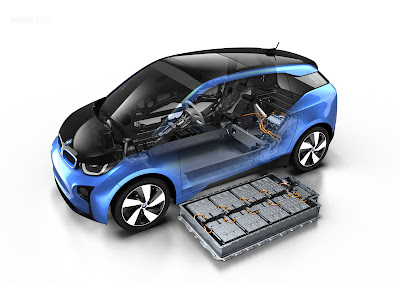
The 2017 i3's 33.4 kWh battery pack is the same physical size as the current 21.6 kWh pack. BMW purposely designed the battery tray this way, so that future battery upgrades would be possible. Allowing the i3's battery to be upgraded was always BMW's plan. The concept of upgrading an electric vehicle's battery pack is certainly not a new one. In fact, it's something that many EV owners have been vocal about wanting to see offered. So the news that BMW will begin a battery upgrade program for their current i3 owners is good indeed, even if it may be something that isn't really necessary, or practical - yet. The big news in BMW i's May 2nd press release was, as expected, that BMW would be upgrading the i3's battery cells from 60 Ah to 94 Ah. This means the 2017 i3 will have an EPA range of 114 miles, up from the current 81 miles per charge. These new battery cells are physically the same size as the currently used cells, but can hold 50% more energy and ar...

It's Official: The 2017 BMW i3 Will Have New Battery, Moonroof Option, New Colors & More

Image
The 2017 i3 comes with 40% more range than the current model. It's also available in a nice new color: Protonic Blue The worst kept secret of the BMW i3 is officially no longer a "secret". BMW has formally announced that the 2017 i3 will have a new, longer range battery pack. They are indeed using the new Samsung 94 Ah battery cells that I speculated they would five months ago . Just as I predicted the new battery pack is increasing from 21.6 kWh to 33.4 kWh, which in an increase in capacity of about 50%. However the range of the i3 BEV will only increase by 40% from 81 miles per charge to 114, which is less than i predicted. That's because BMW is now using a larger buffer (the difference between the total battery capacity and the usable capacity) and also because the car now weighs more (roughly 100 lbs more) because the new higher capacity cells weigh slightly more than the ones they replace.  The slight increase in weight will likely only have a very minor effect o...

Battery Options for the 2017 BMW i3?

Image
A Samsung employee shows of one of the new 94Ah battery cells which I predict the 2017 i3 will boast Ever since last October when  BMW CEO Harold Krueger stated that the 2017 i3 would have an increased electric range, there's been speculation on how they would accomplish it. While BMW hasn't made any official  announcements yet, it's widely believed that BMW will be using the new Samsung 94Ah battery cells for the 2017 i3, which I first speculated here, back in November.  The current i3 uses 96 Samsung 60Ah battery cells which are 3.75v ea. This adds up to a total of 21.6kWh (96 x 60 x 3.75= 21.6). The new 94Ah cells are the same physical size and voltage so an upgrade to these cells would mean BMW could use the same modules and battery tray, greatly reducing the cost as compared to engineering all new packaging for the new cells. Therefore, the new pack should increase from 21.6kWh to 33.8kWh (96 x 94 x 3.75 = 33.8). If the weight of the cells is the same, that should in...